

In politics, as in life, we often frame situations as tradeoffs. In this case, should Democrats in Congress spend their energy holding the administration accountable, or on lowering costs for families? Most voters and elected officials don’t see it as either/or, they want both. But Congress has finite time, attention and leverage, so we wanted to know what happens when you make people pick.
Two-thirds choose costs
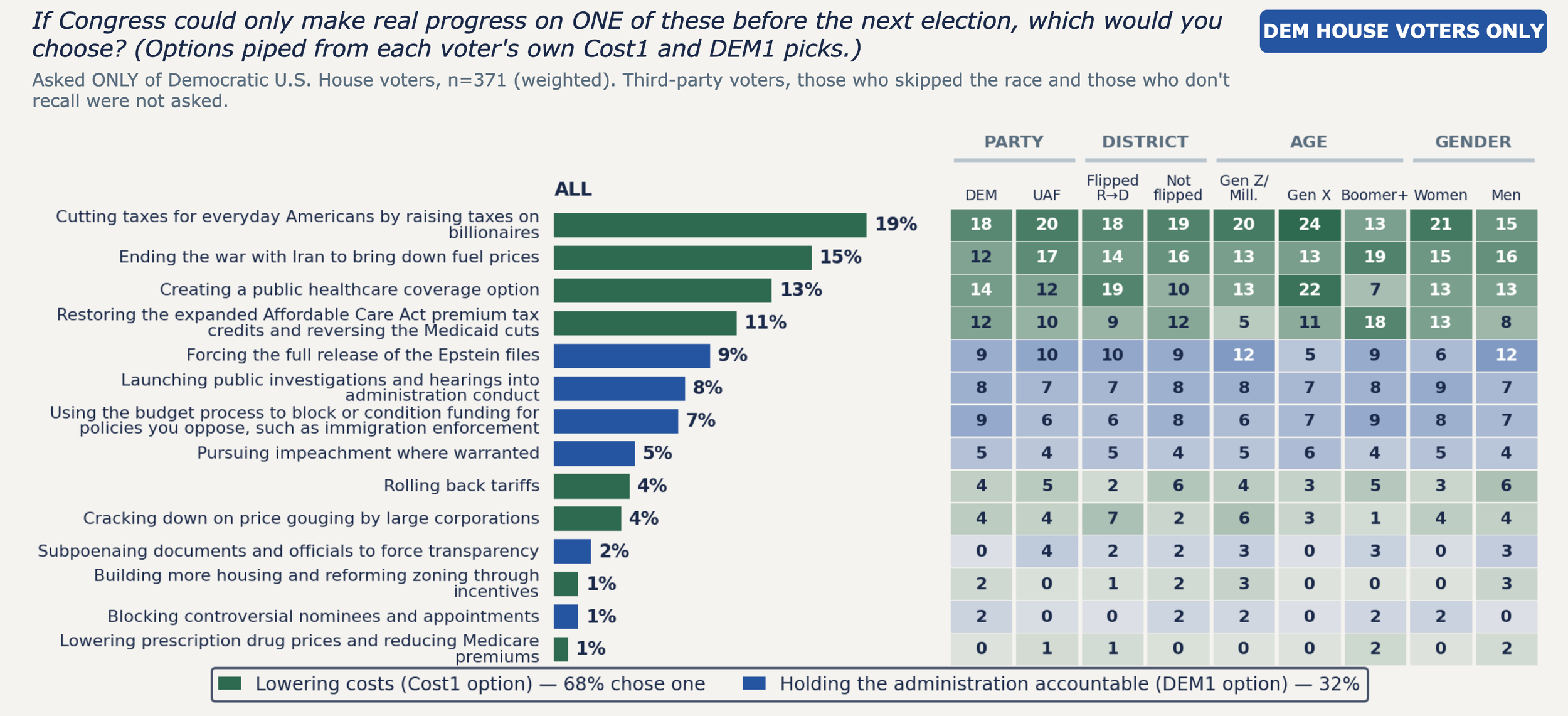
We asked these voters (n371, MOE 5.4%) to name the one priority on which they most want Congress to make real progress, from a list that mixed cost-of-living measures with accountability measures. Sixty-eight percent picked a cost-reduction measure. Thirty-two percent picked an accountability measure.
The result held across very different mindsets. Regardless of positions taken on Congressional leadership, where they live, or what generation they come from they landed in nearly the same place. The 2:1 majority stands up across party registration, age, gender and region.
Wide support, less urgency
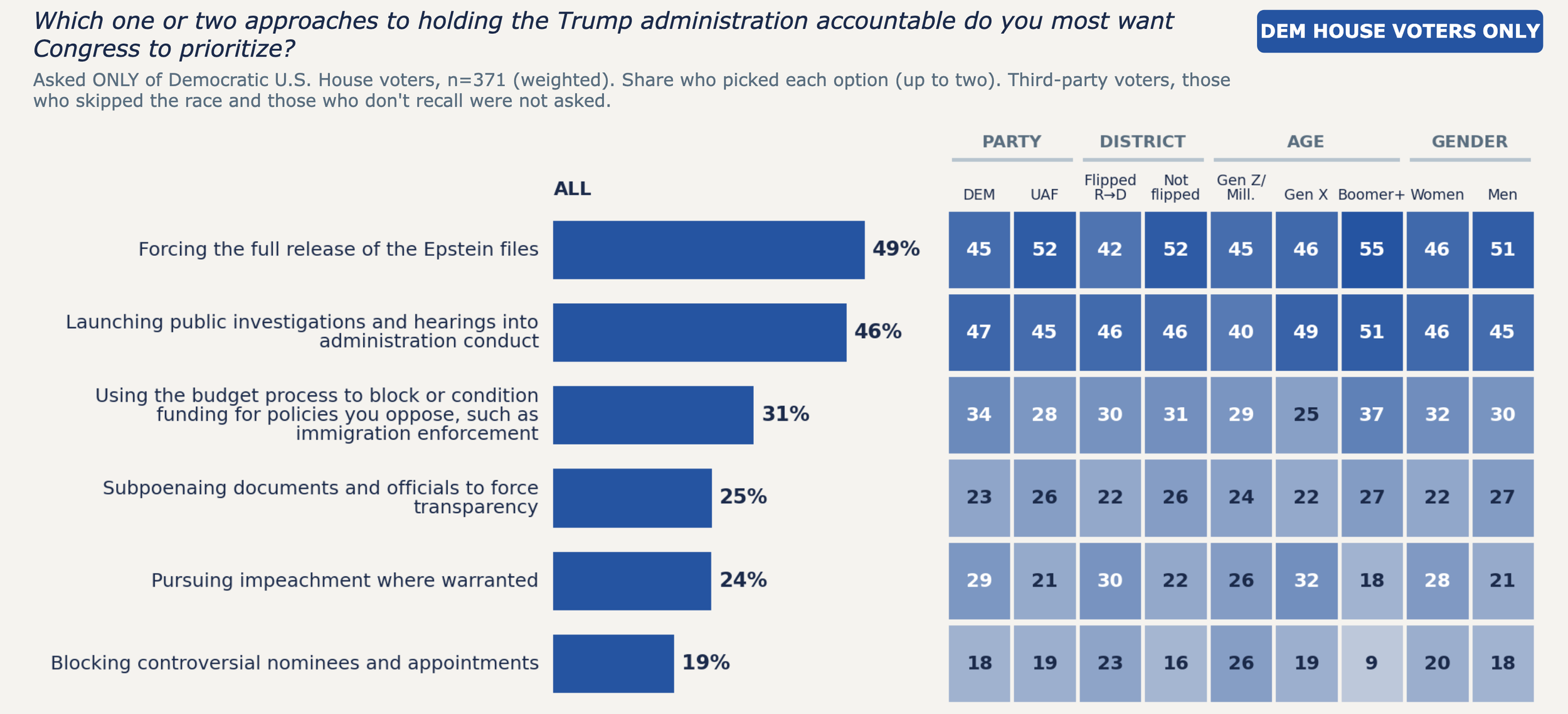
When we let Democratic voters pick up to two accountability measures, support was broad: 49% chose forcing the full release of the Epstein files, 46% chose launching public investigations and hearings.
The drop-off came when we forced a single choice. The Epstein files fell to 9% as the #1 priority and hearings to 8%. Voters like these measures. They just don’t rank them ahead of cost concerns.
What sits at the top instead
The leading #1 singular priorities were all about the household budget: cutting taxes for everyday Americans by raising taxes on billionaires (19%), ending the war with Iran to bring down fuel prices (15%), creating a public healthcare coverage option (13%), and restoring the expanded ACA premium tax credits and reversing the Medicaid cuts (11%). No single accountability measure topped 9%.
Some cost concerns cross party lines
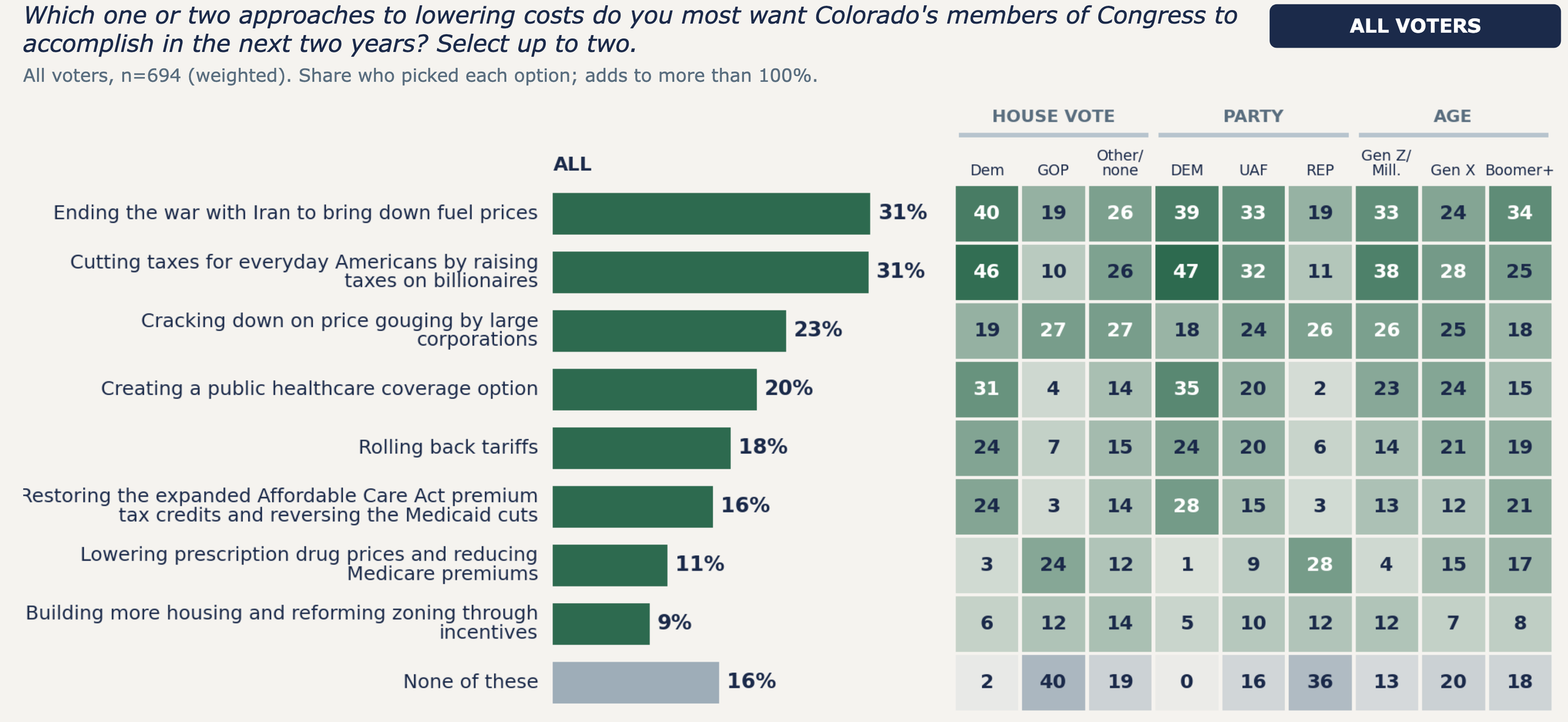
Among all respondents (n694, MOE 4.0%), no single cost measure dominated. Raising taxes on billionaires to cut taxes for everyday Americans and ending the war with Iran each drew 31%. Cracking down on price gouging (23%) and creating a public health insurance option (20%) followed.
Two items stood out for their cross-party appeal: cracking down on price gouging and ending the war with Iran. These were the only cost measures chosen by at least 19% of Democratic-voting and Republican-voting respondents alike. One more number worth noting: Republicans second priority was lowering prescription drug prices and Medicare premiums. An issue chosen 8x more than Democrats.
What this does and doesn’t say
This is not a finding that Democratic voters want Congress to drop oversight. Large shares want it, and the forced-choice format deliberately sets up a competition that many voters wouldn’t see in real life. What it does show is that when attention and political capital are limited, these voters have a clear order of priorities, and that order holds even among the voters most eager to see their party fight.
A caution on the data: the Democratic-voter sub-sample is 371 respondents, so differences of a few points between groups, and anything at the district or generational level, shouldn’t be over-read.
Takeaways for lawmakers
For members of Congress a few practical points follow from the data:
Lead with costs. For these voters, results on the household budget come first, even when accountability is part of the agenda.
Don’t read breadth as intensity. A measure that most voters support is not necessarily one they want prioritized.
Look for common ground. Price gouging and fuel prices were the cost issues with the widest cross-party reach.
About the survey
The Blue Avalanche survey was conducted by Colorado Community Research from November 14 to 16, 2026, among 694 Colorado voters via text-to-web. The margin of error for the statewide sample is ±4.0 points. The questions on Democratic leadership were asked of the 371 respondents who voted for the Democratic candidate in their congressional district race. The margin of error for this group is ±5.4 points. Results for smaller subgroups carry larger margins of error.
About CCR: Colorado Community Research is a polling, survey research, and campaign consulting firm based in Boulder.